
Published on: 16 okt 2026

Why is Data Governance important for data-driven organizations?

AuteurMike van DamFunctieData Engineer

Tag(s)

Data Governance Expert

What is Data Governance?

Data Governance is how organizations make data usable at scale

Data Governance is often associated with compliance, documentation, or management oversight. Those aspects matter, but they are not the main purpose. At its core, Data Governance is about making data usable across the organization by creating clarity about which data is available, which data can be trusted, and who is responsible for data, definitions, and changes.

This becomes increasingly important as organizations scale their data platforms, analytics capabilities, self-service BI initiatives, data products, and AI use cases. Without governance, growth often creates complexity: multiple versions of the same metric, unclear ownership, inconsistent definitions, and limited trust in reports or models. With effective governance, the same growth becomes scalable because teams know where to find data, how reliable it is, and who to involve when definitions or data products need to change.
AuteurMike van DamFunctieData Engineer

Tag(s)

Data Governance Expert

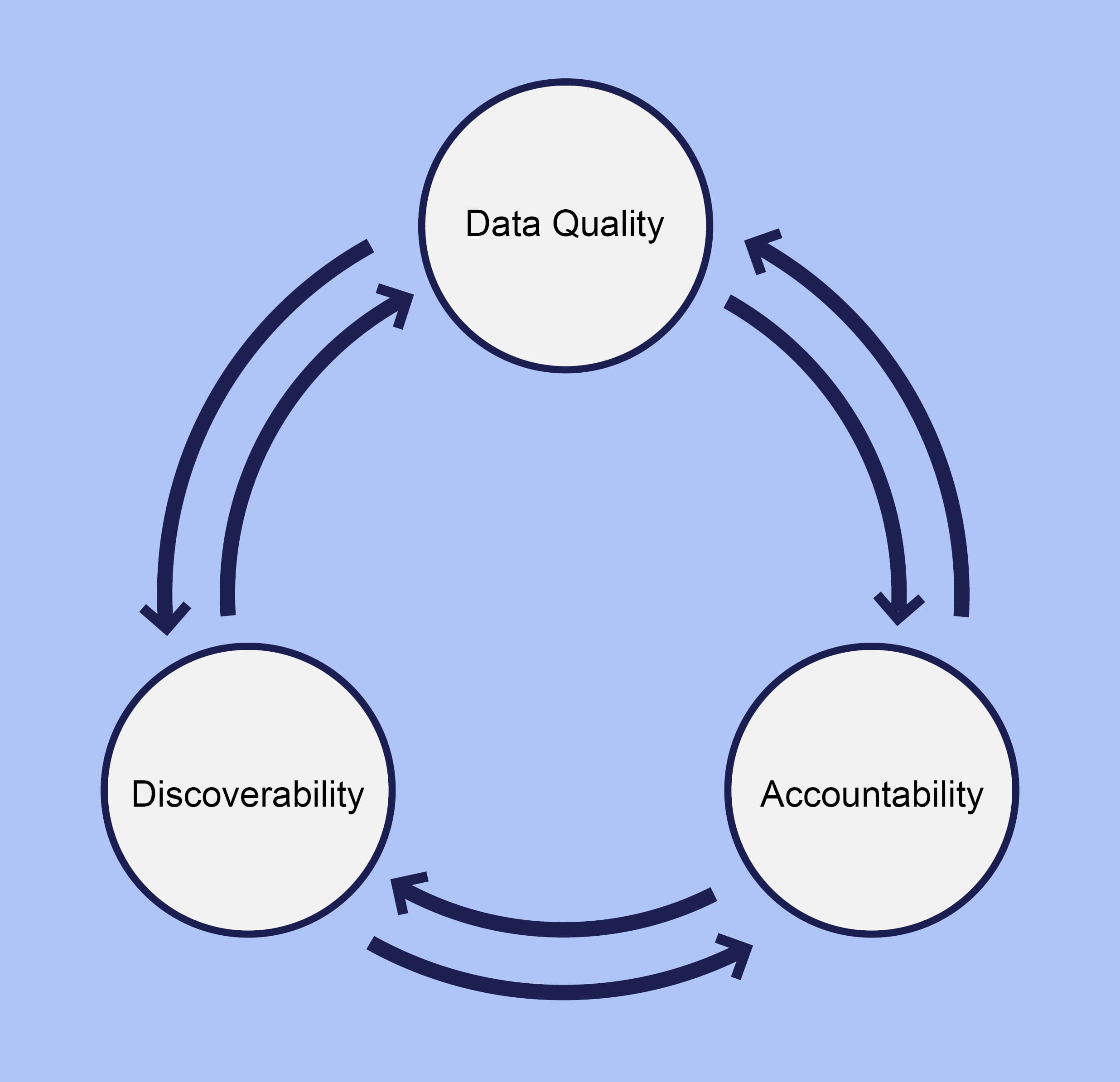
In previous blogs, we described three practical pillars of Data Governance: Accountability and Ownership, Data Quality Management, and Data Discoverability and Metadata. These pillars are most effective when they reinforce each other. Clear ownership makes it easier to improve data quality and maintain definitions. Reliable quality increases trust and adoption. Strong metadata and discoverability help users find the right data product, understand its context, and identify the responsible owner.

What are the business benefits of Data Governance?

A well-implemented Data Governance approach creates business value by reducing friction in how people use data. It does not slow the organization down; it gives teams the clarity they need to move faster with confidence.

  • Developing better data products in a shorter time:

    Clear ownership helps teams align data product development with business priorities. A data product owner can decide which use cases matter most, clarify definitions with stakeholders, and prevent development teams from spending time on features that do not create value. For example, a sales performance dashboard becomes easier to deliver and adopt when one owner is responsible for the metric definitions, quality expectations, and change requests.

  • Enabling faster and better business decisions:

    Decision-makers need to know not only where to find data, but also whether they can trust it. When definitions, quality indicators, and ownership are visible, managers spend less time reconciling conflicting numbers and more time acting on insights.

  • Increasing adoption of analytics and self-service BI:

    Business users are more likely to use data products when they understand what the data means, where it comes from, and who stands behind it. For example, when the Finance department actively owns and explains an internal Power BI report, users are more inclined to trust the report and use it in recurring decision-making.

  • Creating a scalable foundation for growth:

    As data platforms expand, governance helps avoid duplicated datasets, unclear ownership, and inconsistent definitions. This is especially important when organizations move from a small number of centrally managed reports to a broader ecosystem of data products, analytics teams, and AI-enabled workflows. Compliance also benefits from this clarity, but it becomes a natural outcome of good governance rather than the only objective.

Why is Data Governance important for AI?

The adoption of AI makes Data Governance even more important. AI initiatives often fail to scale not because the model is weak, but because the data foundation underneath it is unclear. If an AI solution cannot identify the right source, understand the business definition, assess data quality, or respect ownership and access rules, its output will be difficult to trust.

AI depends on reliable data quality

Models, copilots, and analytical agents are only as useful as the data they consume. If customer, revenue, or operational data is incomplete, inconsistent, or poorly defined, AI can produce outputs that look convincing but lead to the wrong decision. Governance reduces this risk by making quality expectations explicit and by assigning responsibility for monitoring and improving critical data.

AI needs strong discoverability and metadata.

In traditional reporting, users often select a predefined dashboard or dataset. In AI-enabled analytics, a user may simply ask a question such as “What was the revenue for department X last year?” To answer correctly, the system needs to find the right dataset, understand the approved definition of revenue, apply the right filters, and respect the relevant access rules. A data catalogue, clear business glossary, lineage information, and ownership model help make that possible.

AI requires stronger control over sensitive data

The use of large language models creates additional risks, particularly when they are trained or grounded on sensitive enterprise data. Because these models learn patterns from the data they consume, unnecessarily exposing confidential, personal, or proprietary information can introduce privacy, security, and compliance risks. Data Governance helps mitigate these risks by defining which data is appropriate for each AI use case, limiting model access to only the data that is required, and ensuring that sensitive data is classified and protected from processing when it is not needed. This requires organizations to understand the origin, sensitivity, and lifecycle of their data and to enforce appropriate access and usage controls throughout the AI lifecycle.

From technical asset to trusted business capability

Data Governance is not about adding bureaucracy around data. It is how organizations turn data from a technical asset into a trusted business capability. When governance creates clarity around availability, quality, definitions and ownership, teams can make better decisions, increase adoption of data products, scale analytics and build a stronger foundation for AI. The real value of Data Governance is therefore not the governance itself. It is what the organization can do once people and systems can confidently find, understand and use the right data.

Want to see what effective Data Governance looks like in practice? Explore how Blenddata helps organizations create scalable, trusted data platforms and turn governance principles into working solutions.

What is effective governance for your company?

We’d be happy to help you get started.

Contact

Roel Smits

Co-founder | Data Architect