Data serving: how can you make data useful for your organisation?
AuteurKevin BeversFunctiePlatform Engineer
Tag(s)
Data Serving Introduction
Storing data in a data warehouse or data platform does not automatically mean that the data can be used. Many organisations face this problem: they have a data platform and a team to maintain it, but the data itself remains difficult for many people and applications to access.
Data serving involves making reliable, processed data available to users, applications and AI applications. It forms the final layer of a data architecture: the step between processing data and actually using it.
AuteurKevin BeversFunctiePlatform Engineer
Tag(s)
Data Serving Introduction
What is data serving?
Data serving is the final step in a data architecture. It is where data actually becomes usable. The data serving layer ensures that processed data is made available in a controlled manner to the people and applications that need it.
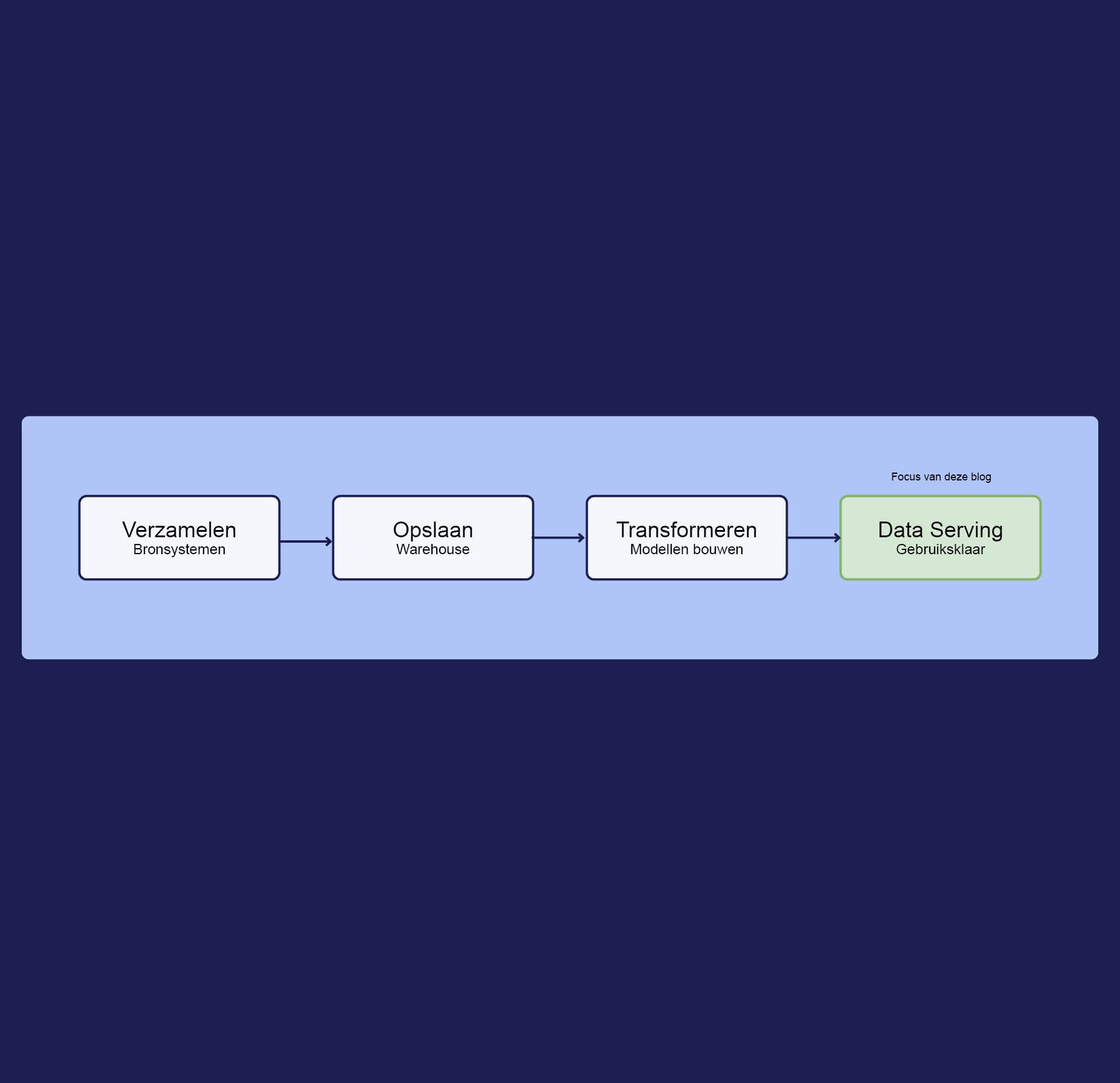
The process looks broadly as follows:
Data collection: Retrieving data from source systems.
Data storage: Data is stored in a data platform or data warehouse.
Data transformation: Raw data is converted into reliable data models.
Data serving: The data is made available for use.
Without that final step, all the work that goes before it remains largely theoretical. You can have the most beautifully modelled platform, but if nobody can access the data, it’s of little use.
What is the difference between data transformation and data serving?
Data transformation and data serving fulfil different functions within a data architecture. Data transformation involves cleaning, combining and converting raw data into reliable data models. Data serving then determines how that processed data is made available to users and applications.
In short: data transformation makes data reliable; data serving makes that data accessible.
How does data serving work?
Different applications consume data in different ways. The data serving layer must be flexible enough to accommodate this. In practice, we see, amongst other things:
Tables and views for traditional BI, analyses and reports.
Semantic layers that centralise definitions and calculations, so that, for example, ‘turnover’ means the same thing everywhere.
APIs that allow applications to retrieve data in a targeted and controlled manner.
Real-time data streams for applications that cannot wait for a daily batch.
Vector databases for AI applications where searching by content and meaning is more important than an exact match.
Which form is most suitable depends on who or what uses the data, and how quickly and how often this happens. In most organisations, the answer is a combination of the forms listed above.
Data serving is therefore not a specific technology or tool. It is a component of the data architecture that determines how reliable data is made available for use.
Data serving for GenAI
The same layer that enables BI can also form the basis for GenAI applications. An AI assistant that answers questions about your organisation needs access to reliable and up-to-date business data, not just a language model with generic knowledge.
This can involve both structured and unstructured data: from tables and KPIs to documents and other textual information.
Data serving plays a role, for example, in:
Structured and unstructured data, from tables to documents.
RAG and vector databases, which enable relevant information to be found based on the content and meaning of a question.
Governance and access management, ensuring that an AI assistant does not display more information than a user is actually authorised to see.
For GenAI, therefore, data serving is not just about making data accessible. Reliability, timeliness and access rights must also be properly managed. Otherwise, you will still be providing a smart application with the wrong information. A data serving layer must be tailored to the way data is used within your organisation. A number of key considerations recur in practice.
What should you bear in mind when it comes to data serving?
A data serving layer must be tailored to the way data is used within your organisation. A number of key considerations keep cropping up in practice.
Performance and scalability
A dashboard that is updated once a day has different requirements to an application that needs data to be constantly up to date. You should therefore consider not only today’s volume of data, but also the number of users, applications and data streams you expect in the future.
Data quality
Making data available is only valuable if users can rely on it. Consistent definitions, up-to-date data and clear agreements on the meaning of the data are therefore important. This is particularly true when the same data is used by different teams and applications.
Security and governance
Not every user or application should have access to the same data. Access control must therefore form part of the serving layer. This prevents sensitive data from ending up in the hands of someone who is not authorised to access it via a dashboard, API or AI application.
Maintainability
As more applications make use of the same data, maintainability becomes increasingly important. Centralised definitions and reusable datasets prevent the same logic from having to be rebuilt in more and more places. This means that a change does not need to be implemented in ten different dashboards or applications.
Data serving as part of your data platform
Data serving does not stand alone. It is part of your data platform as a whole.
A good data platform does more than just collect and process data. It also ensures that reliable data reaches the right user or application, whether that is a dashboard, an application, a machine learning model or an AI assistant.
This is how you make the transition from simply storing data to actually utilising it for your organisation.
Conclusion
Data serving is the way in which you share data with the people and applications that need to work with it. All the work involved, from collection and storage to transformation, only really counts once the data can actually be used.
A well-designed serving layer prevents every new use case from having to start from scratch. The same reliable data can be used for dashboards, applications, analyses and AI, whilst definitions and access rights remain centrally managed.
Frequently asked questions about data serving
Frequentlyaskedquestionsaboutdataserving
What is data serving?
Data serving involves making reliable, processed data available to users, applications and other systems. It is the final step between processing data and actually using it.
What is a data serving layer?
A data serving layer is the component of a data architecture that determines how processed data is made available to, for example, BI tools, APIs, applications and AI applications.
What is the difference between data serving and data transformation?
Data transformation converts raw data into reliable data models. Data serving then ensures that this data is made accessible to the people and systems that work with it.
What technologies are used for data serving?
That depends on the application. For example, data can be made available via tables and views, semantic layers, APIs, real-time data streams or vector databases. In many data architectures, several of these forms are combined.
Why is data serving important for AI?
AI applications require access to reliable, up-to-date and verified business data. Data serving helps to make that information available whilst taking data quality, governance and access rights into account.
MakingdataavailableforBI,AIorapplications?
Is the data actually there, but isn’t it reaching the people or applications that need it? Or do you already have a data-serving solution, but has it become unsuitable for your organisation’s needs?
Please feel free to get in touch. We’d be happy to help you work out which solution best suits your data architecture and how you can build it up step by step.